 Sev Leo, Founder of PineLead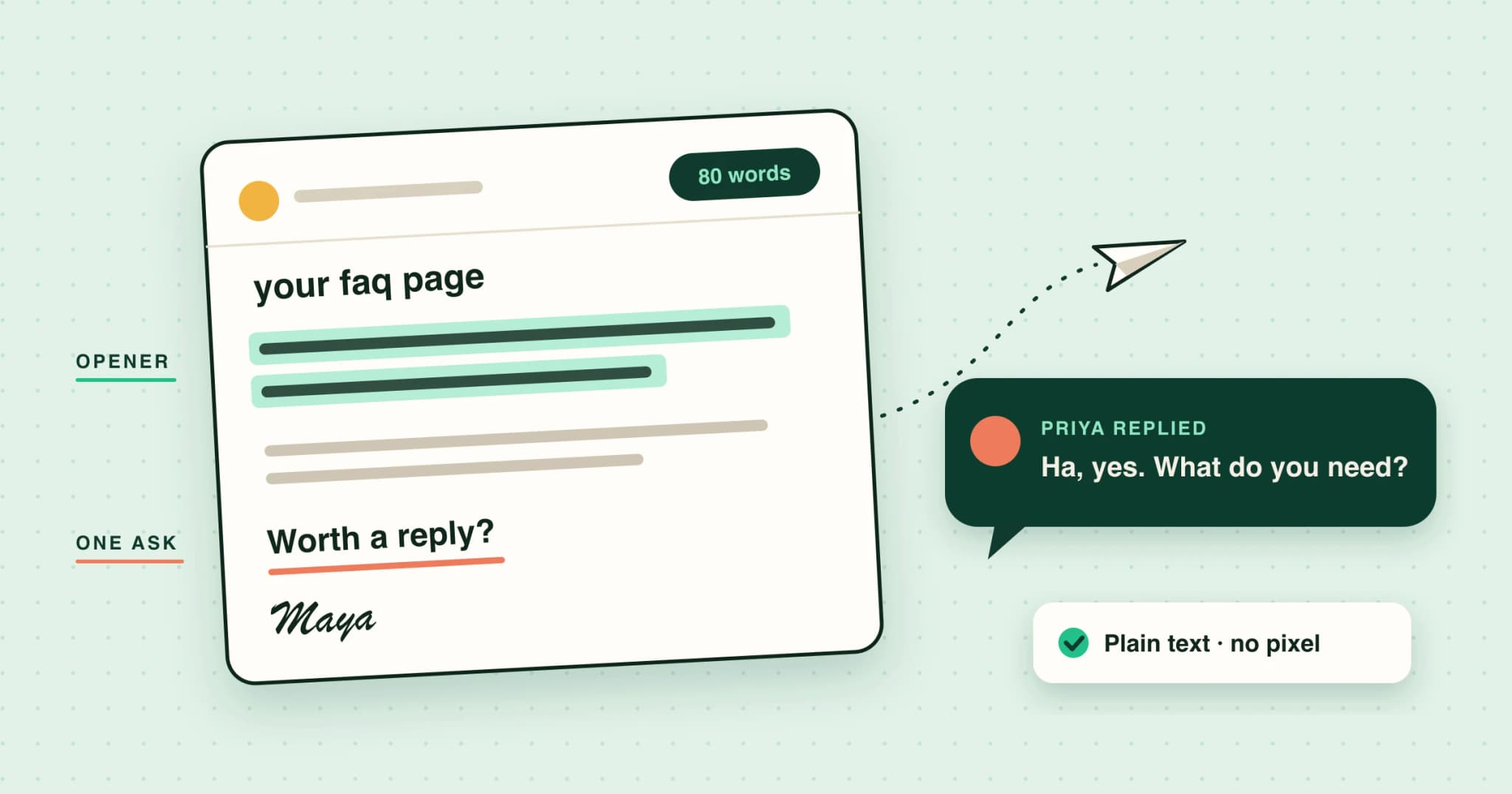
Every cold email vendor publishes benchmarks, and the headline numbers disagree by a factor of seven. Read the methodology, though, and they agree on more than you’d expect: short emails, specific openers, small asks, a couple of follow-ups. This is what 2026’s data says about the first email, the one that decides whether there is a second.
What a good reply rate looks like
| Source | Sample | Average reply rate | How it counts |
|---|---|---|---|
| Instantly 2026 | “Billions” of 2025 interactions | 3.43% (top quarter 5.5%+, top 10% 10.7%+) | Per recipient |
| Hunter 2026 | 31M emails sent in 2025 | 4.5% (sales outreach alone 3%) | Per sequence recipient |
| Belkins 2026 | 7.5M emails sent in 2025 | 0.45% | Per email sent, auto-replies excluded |
The spread comes mostly from the denominator. Belkins divides replies by every email sent, follow-ups included. Instantly and Hunter divide by people contacted. lemlist notes that published benchmarks differ by as much as 7.6x (lemlist). All of this is vendor data from vendors’ own users, so treat it as direction, not physics. Compare yourself against your own past numbers, counted the same way each time.
One encouraging result if you sell to startups: in Belkins’ data, founders and owners replied more than VPs (0.57% vs 0.32% per email), and companies with up to 10 employees replied more than three times as often as companies with 10,000+ (0.72% vs 0.22%) (Belkins).
Within a single dataset, where everything is counted the same way, the habits below moved reply rates the most. They are correlations, not controlled tests, but they point the same way as the rest of this article.
Reply rates with and without six habits
Average reply rate in Hunter’s 2026 report, 31 million emails sent by its users in 2025.
Length: short, but not a hard limit
Most datasets point the same way. Gong’s analysis of 28 million cold emails favors 100 words or fewer in three or four sentences (Gong). For executives it found 50–100 words best, with replies dropping sharply past 100 (Gong). Instantly’s top senders keep first emails under 80 words (Instantly).
The effect is smaller than the advice suggests, though. Across 34 million emails, Hunter found every length band between 3.4% and 4.5% replies (Hunter), and its 2026 data shows a second peak at 181–200 words (Hunter). So aim for 50–100 words, and treat length as a symptom: a long email is usually one that pitches. Make it easy to read, too. Lavender says emails written at a 3rd–5th grade reading level get 67% more replies (Lavender).
Subject lines: short and specific
- Belkins: 2–4 word subjects opened at 46%, 10-word ones at 34%. Personalized subjects got 7% replies against 3% (Belkins).
- Gong: 1–4 words did best with executives (Gong).
- Hunter: 5–6 words was its sweet spot, and “Quick question” got just 2.5% replies (Hunter).
Write it the way a colleague would: lowercase, a few words, about them (“your faq page”, “the google doc”). Don’t lean on open rates to test it. Apple’s Mail Privacy Protection “stops senders from using invisible pixels to collect information” (Apple), so opens are inflated and noisy. Judge subject lines by replies.
Personalization: research beats merge tags
Personalization works when it shows you understand the company’s situation, and fails when it’s a field dropped into a template:
- Gong: mentioning a company-specific topic tripled reply rates from directors and above (Gong).
- Hunter: two custom attributes in the body lifted replies from 3.6% to 5.6%, and manually edited emails beat fully automated ones, 5.2% to 4.4% (Hunter).
- Reply.io: plain merge variables lowered replies by 6% (Reply.io).
The opener that works is one true, specific observation that could only be about them, ideally the same problem your qualification criteria looked for. A tagline read back to them, or a compliment about their “impressive growth”, reads as automated, and 69% of US decision-makers in Hunter’s survey said it bothers them when AI wrote the email. The lesson isn’t to avoid AI, but to never send something that reads like it was generated.
The ask: interest, not a meeting
Gong’s study of 304,174 emails found an interest-based call to action (“Worth a reply?”, “Open to it?”) worked best on cold email. Asking for a specific time succeeded about 15% of the time cold, against 37% once a deal was underway (Gong). Ask for a meeting once there is a conversation. Separately, Gong found that pitching cuts reply rates by as much as 57% (Gong). One or two sentences on what you do is enough. The first email is for earning a reply, not for closing.
Follow-ups: where the data disagrees
Instantly says 58% of replies come from the first email (Instantly). Belkins says steps two to six bring 58.6% of replies (Belkins). Both can be true: they count different campaigns in different ways. What everyone agrees on is that following up helps. In Hunter’s data, three messages got 6.8% replies against 3.3% for one (Hunter), and unsubscribes rose after the third follow-up (Hunter 2025).
A sensible default is two or three follow-ups, the first after two or three days and later ones four to seven days apart (Instantly). Each should add something, like a useful link or a different angle, and send in the same thread. “Just bumping this” adds nothing. Finish with a polite breakup email rather than a sixth nudge.
Anatomy of a first email
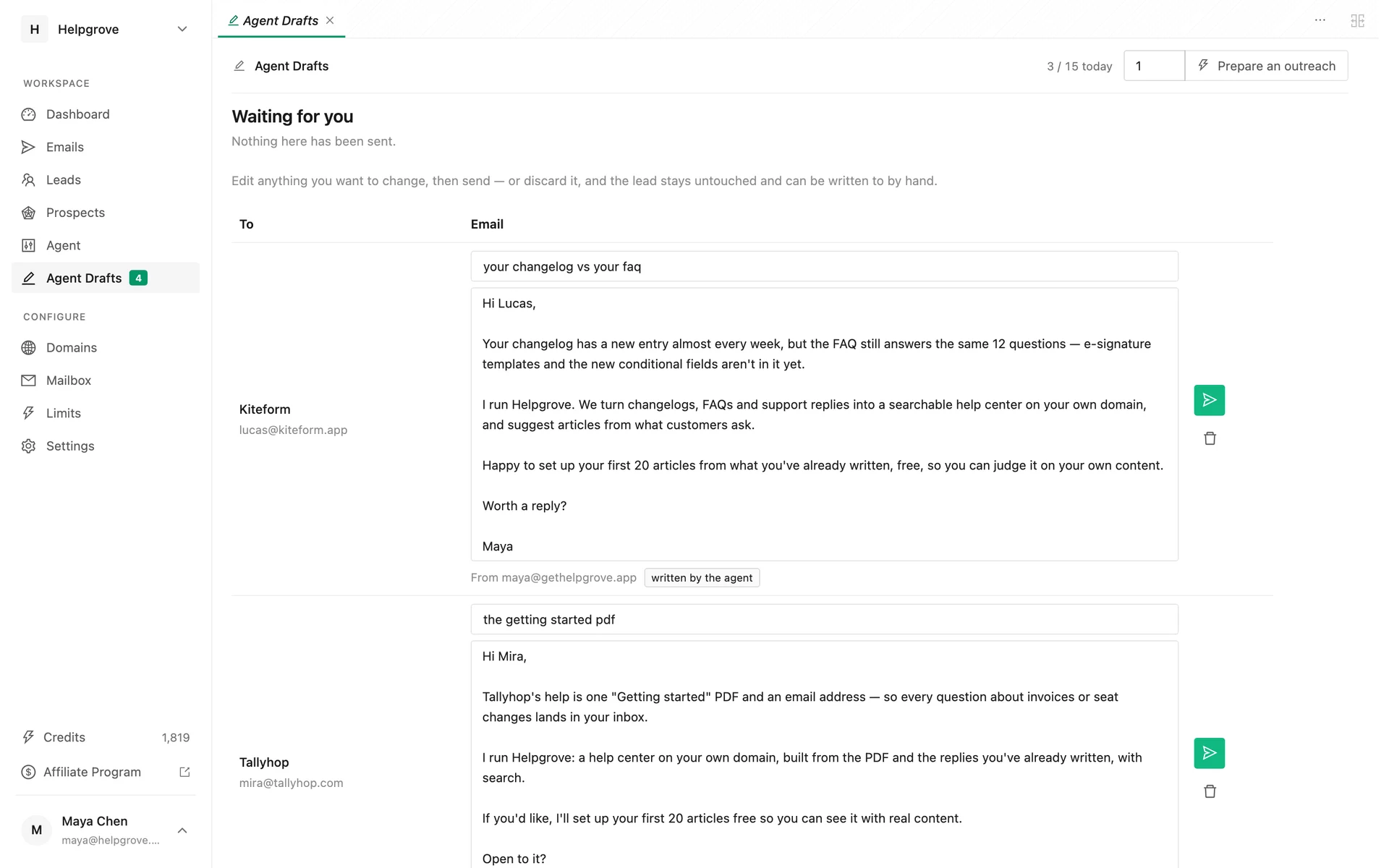
Subject: your changelog vs your faq

Hi Lucas,

Your changelog has a new entry almost every week, but the FAQ still answers the same 12 questions — e-signature templates and the new conditional fields aren't in it yet.

I run Helpgrove. We turn changelogs, FAQs and support replies into a searchable help center on your own domain, and suggest articles from what customers ask.

Happy to set up your first 20 articles from what you've already written, free, so you can judge it on your own content.

Worth a reply?

Maya
- Subject: four lowercase words, about them.
- Opener: one specific, checkable fact from their own site (a weekly changelog, a 12-question FAQ) that is also the problem.
- What you do: one sentence, in their terms.
- Offer: something concrete and low-risk, sized for a stranger.
- Ask: interest, as a question that takes five seconds to answer.
- Sign-off: a first name. No banner, no calendar link. About 80 words in total.
Writing first emails with PineLead
In PineLead
Your voice, its research, your approval
PineLead writes the first email for each qualified lead from the research on that company and the reason it qualified, so the opener comes from the company’s own site. By default it follows the data above: 60–120 words, plain text, at most one link, a short subject about them and a single small ask. It never states a fact it wasn’t given; when the research is thin it writes a shorter email instead of padding it. You change the defaults in three places:
- Limits → Drafting: one or two sentences on what you sell. Without it nothing is drafted, so the agent never invents a product.
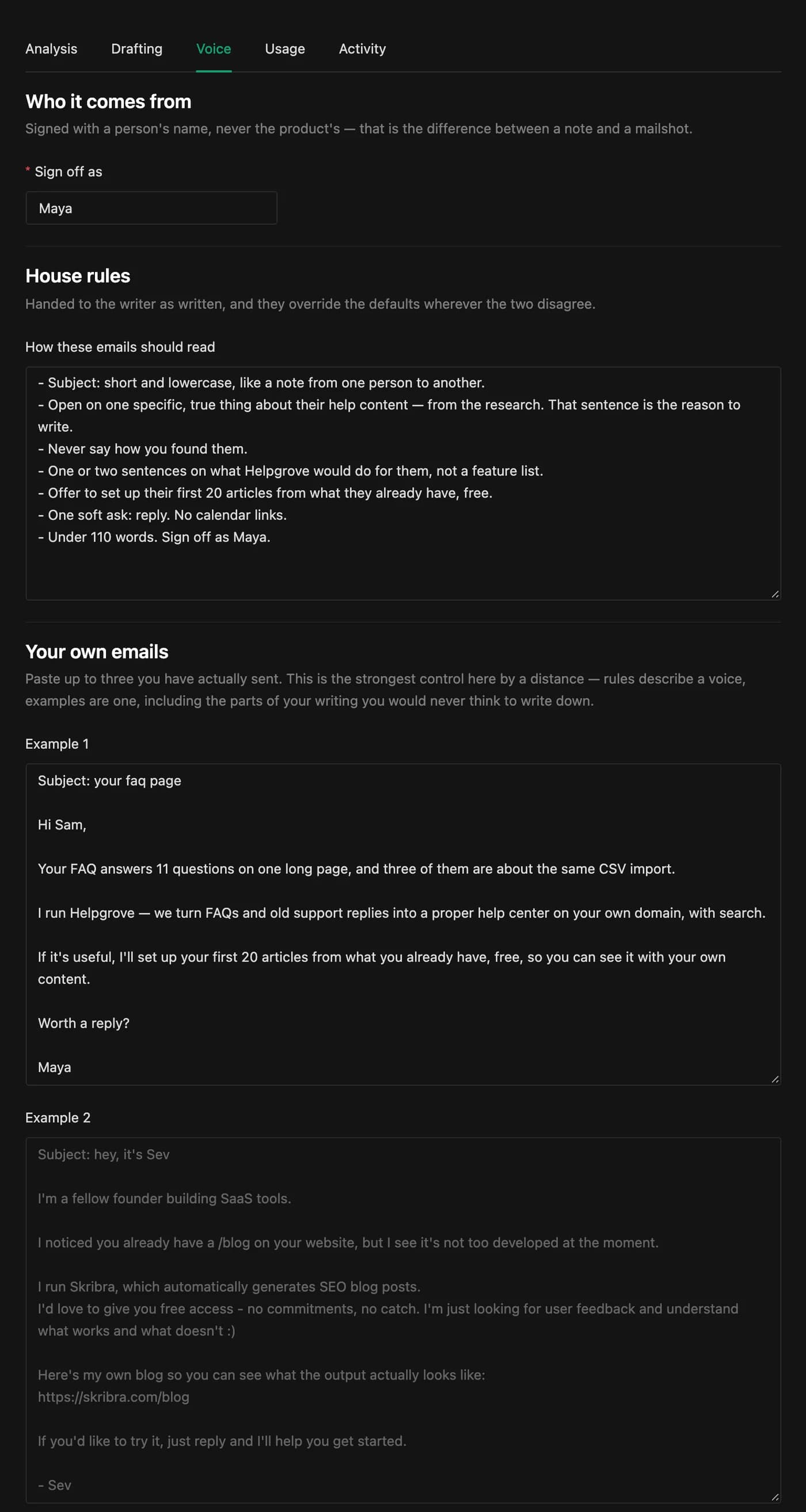
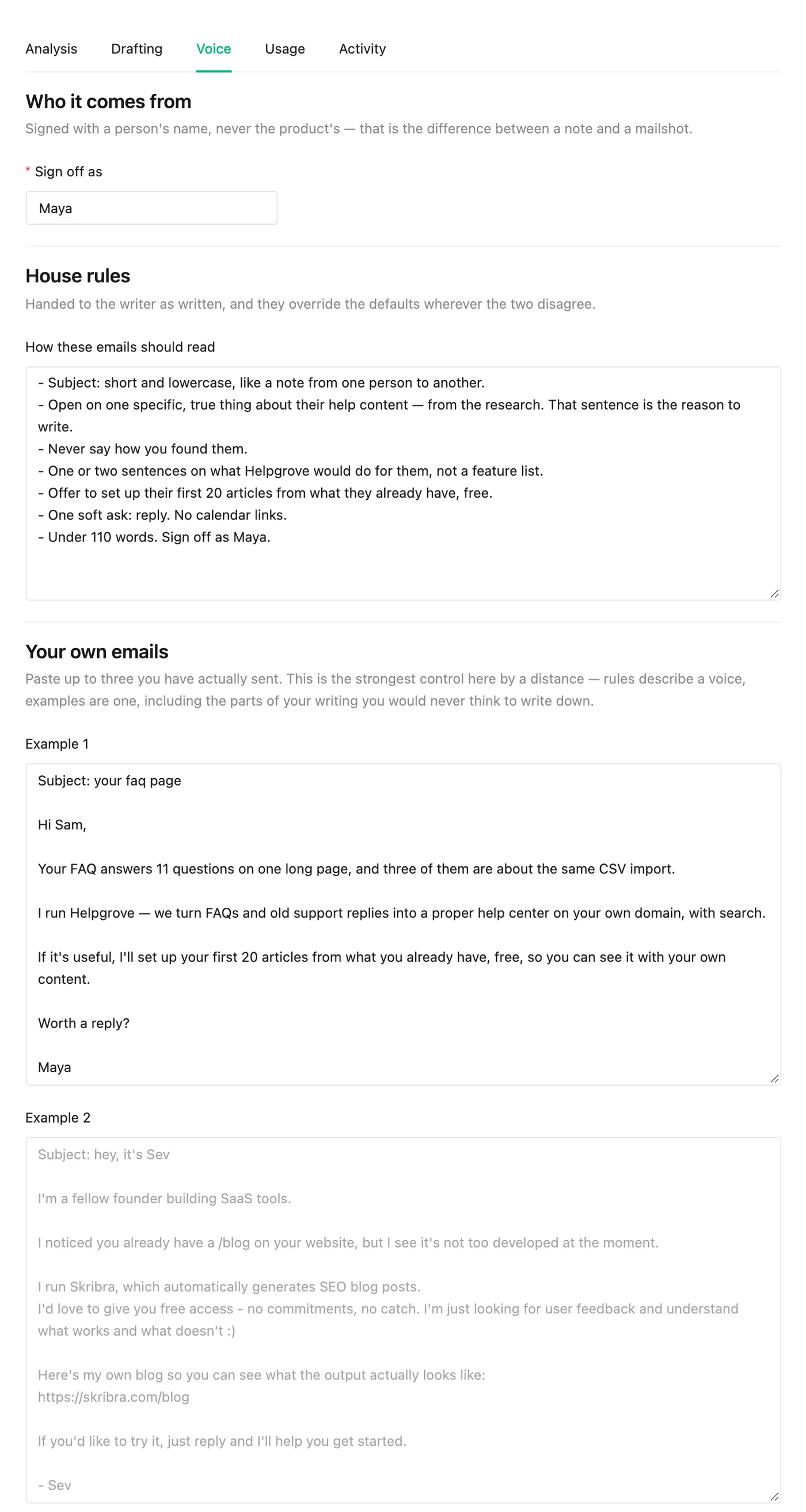
- Limits → Voice: the name you sign with, your house rules, and up to three emails you have actually sent. The examples are the strongest control: they are matched for rhythm and tone, never copied.
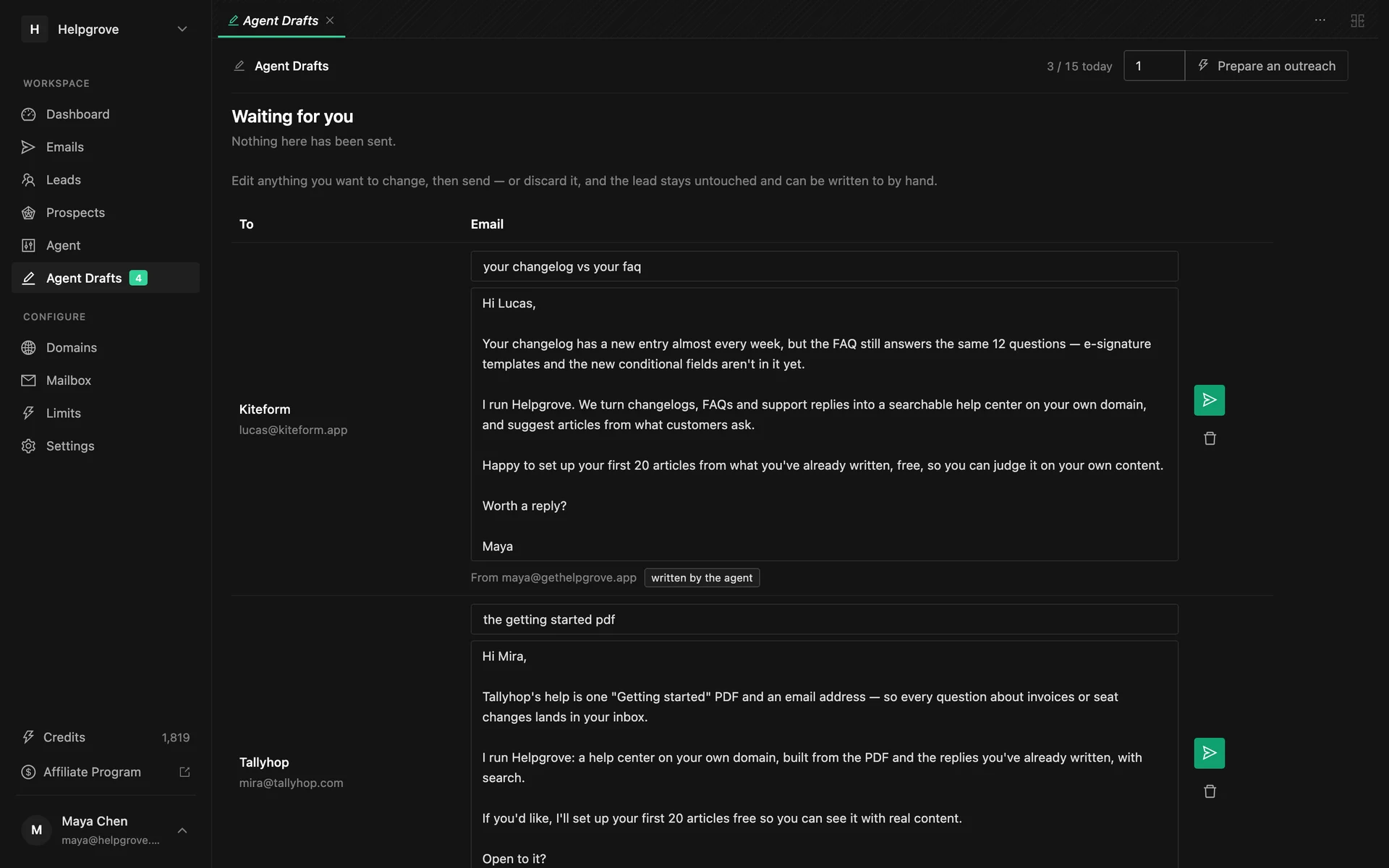
- Agent Drafts: every draft waits here. Edit the subject or body and send it, or discard it. Sending goes from your own mailbox and moves the lead to Contacted.
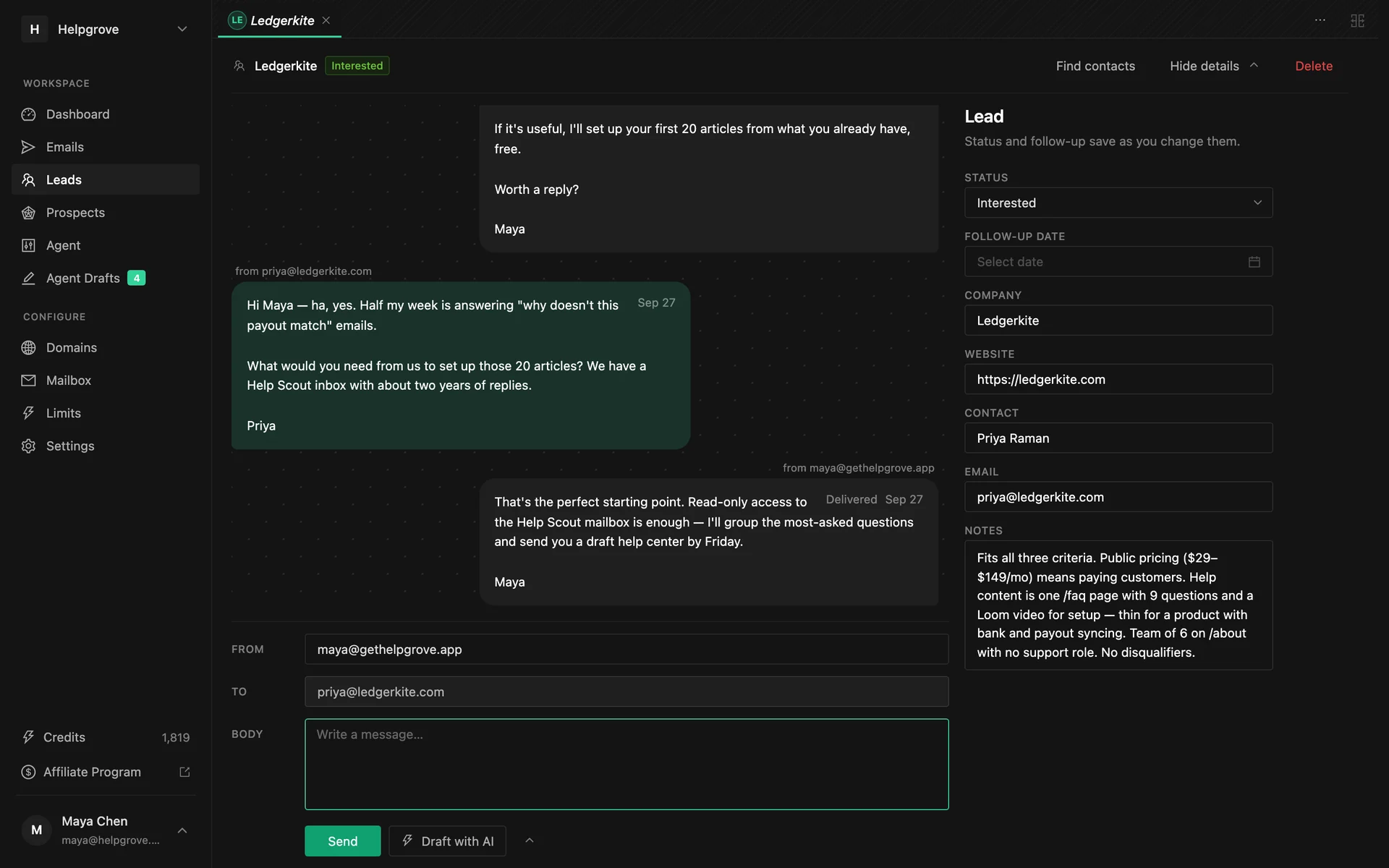
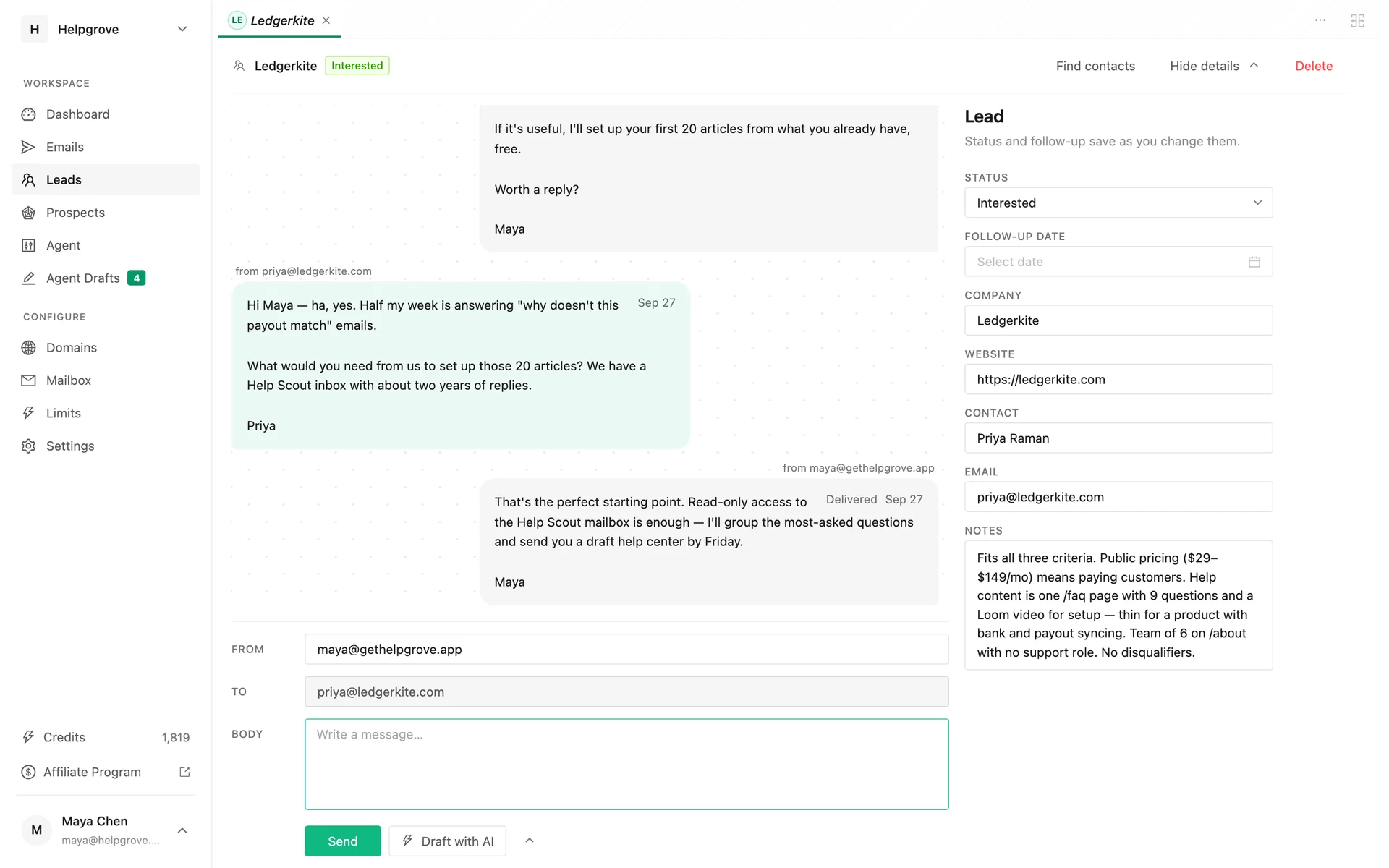
Follow-ups stay with you. PineLead writes first emails and doesn’t run automated sequences. Set a follow-up date on a lead, and it shows under Follow-ups due today on the dashboard. Replies sync back into the lead’s thread, and anything you send from the thread goes out as a reply in the same conversation.
Frequently asked questions
- What is a good cold email reply rate in 2026?
- Counted per person contacted, 3–5% is typical: Instantly reports a 3.43% average with the top 10% above 10.7%, and Hunter reports 4.5%. Counted per email sent, as Belkins does, the average is 0.45%. Compare yourself against your own numbers, counted the same way.
- How long should a cold email be?
- Aim for 50–100 words. Gong found 100 words or fewer in three or four sentences works best, and 50–100 for executives. Hunter’s data shows the effect of length is small, so the real goal is not to pitch.
- How many follow-ups should I send?
- Two or three, each adding something new and sent in the same thread. In Hunter’s data three messages roughly doubled replies over one, while unsubscribes rose after the third follow-up.
- Should a cold email ask for a meeting?
- Not the first one. Gong found interest-based asks such as “Worth a reply?” work best on cold email, while asking for a specific time works far better once a deal is underway.
- Does AI-written cold email work?
- It works when it reads as written for that one company. In Hunter’s 2026 data, manually edited emails beat fully automated ones (5.2% vs 4.4% replies), and 69% of US decision-makers said AI-written email bothers them. Use AI for research and drafts, then review before sending.
Try it on your own market
PineLead finds new B2B prospects every day, researches and qualifies each one against your criteria, and drafts a first email you approve. Start with 100 free credits.
Keep reading
Sources
- Instantly — Cold Email Benchmark Report 2026
- Hunter — State of Email Outreach 2026
- Belkins — Cold email response rates (2026)
- lemlist — Cold email benchmarks
- Gong — Does cold email still work? (28M emails)
- Gong — Do execs reply to cold email?
- Hunter — Cold email word count study
- Lavender — Cold email 101
- Belkins — B2B cold email subject line statistics
- Apple — Mail Privacy Protection announcement
- Gong — 4 data-backed ways to increase your reply rate
- Reply.io — How to write better cold emails
- Gong Labs — The cold email CTA that books more meetings
- Belkins — Sales follow-up statistics
- Hunter — State of Cold Email 2025
- Instantly — Email sequence benchmarks 2026
PineLead
Notes on finding fresh prospects and writing first emails that get a reply.