 Sev Leo, Founder of PineLead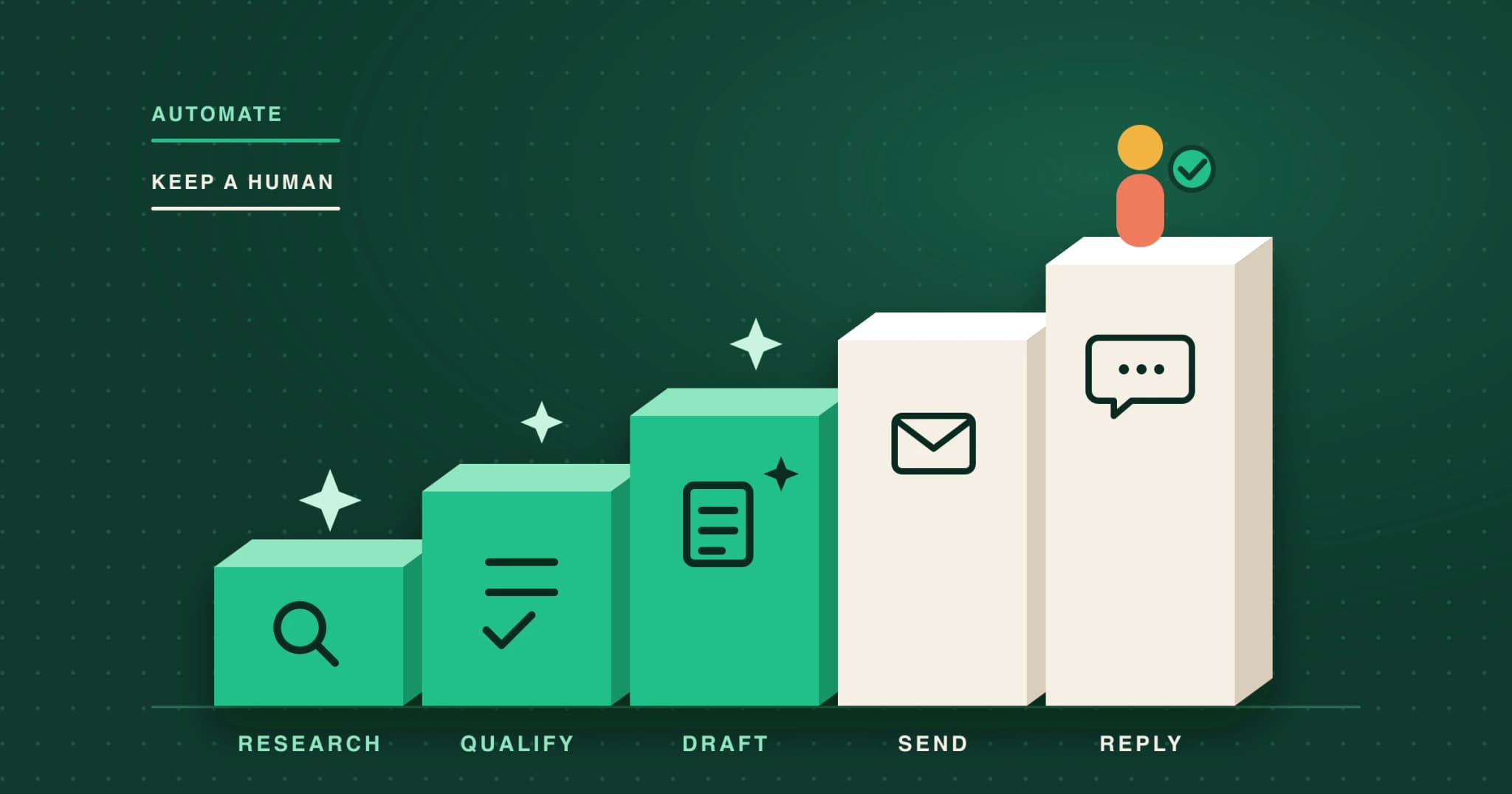
An AI SDR promises outbound on autopilot: it finds prospects, researches them, writes to them, follows up and books meetings while you sleep. Two years in, the evidence is clearer. These tools are good at the research and the first draft, uneven at judgment, and risky when nobody reads what they send. This guide covers what to hand over, what to keep, and what it costs.
What an AI SDR actually does
A human SDR does five jobs before handing a meeting to someone else. An AI SDR is software that does some or all of them:
- Find companies and people who might fit.
- Research each one: what they sell, what changed, who to write to.
- Qualify: decide whether they are worth an email at all.
- Write and send the first email and the follow-ups.
- Handle replies: answer questions, deal with objections, book the meeting.
Products differ mostly in how far down this list they go without asking you, and that one choice drives most of the risk.
What the evidence says it’s good at
Analysts and practitioners draw the line in the same place.
- Gartner, May 2026: “AI is well suited to activities, such as account research, personalized messaging, signal monitoring and next best actions, while sellers remain differentiated in empathy, judgment, contextual understanding and value framing” (Gartner).
- Salesforce’s 2026 State of Sales, from 4,050 sales professionals: reps spend 40% of their time actually selling. They expect agents to cut prospect research time by 34% and email drafting by 36%, and 47% call cold outreach one of the worst parts of the job (Salesforce).
- SaaStr ran AI SDRs for six months: 19,847 outbound messages, a 6.7% response rate, 4% positive. The catch was that the agents “require massive human oversight (15-20 Hours Weekly)”, and results moved with the attention they got (SaaStr).
Gartner also predicts AI agents will outnumber human sellers ten to one by 2028, yet fewer than 40% of sellers will say agents made them more productive (Gartner). More agents don’t automatically mean more pipeline.
Where it goes wrong
- Volume without sales. TechCrunch reported in March 2025 that 11x listed customers it didn’t have. ZoomInfo, one of them, said that during a pilot “11x’s product performed significantly worse than our SDR employees” (TechCrunch). A public company’s CRO told investor Tomasz Tunguz that an AI SDR produced plenty of leads that “did not lead to actual sales” (TechCrunch).
- Invented facts. Artisan’s CEO said his company “had extremely bad hallucinations when we first launched”, and that first-generation AI SDRs “get a pretty low response rate” with “relatively high churn” (TechCrunch). See AI hallucination.
- Readers notice. 69% of US decision-makers in Hunter’s 2026 survey said it bothers them if AI wrote the email, and manually edited emails out-replied fully automated ones, 5.2% to 4.4% (Hunter).
- You own what it says. In Moffatt v. Air Canada (2024), the airline was held liable for what its chatbot told a customer (McCarthy Tétrault). An agent answering prospects on your behalf is making promises in your name.
- Your domain carries the risk. An agent that sends too fast or to unverified addresses burns the mailbox it sends from. See cold email deliverability in 2026.
Even Artisan, whose “Stop hiring humans” billboards defined the category, retired the slogan in August 2026 and hired its first human BDR (Artisan).
The market, compared
Prices as listed on each vendor’s site on October 1, 2026. Check before you buy, because they change often.
| Product | What it automates | Default mode | Public price |
|---|---|---|---|
| 11x (Alice) | Leads, research, multichannel sequences, replies, meetings | Autonomous | From $3,750/mo, billed annually |
| Artisan (Ava) | Lead data, writing, sending, replies, scheduling | Autonomous by default; approval mode available | Not published |
| AiSDR | Researched email and LinkedIn, replies, objections | Autonomous, with a co-pilot option | $250–$2,500/mo (200–2,500 contacts) |
| Amplemarket (Duo) | Signals, multichannel drafts, reply drafts | Suggests; you send | From $600/mo, annual |
| Apollo | Database, sequences, research and optimization agents | Agents propose; you review | $49–$119/seat/mo, annual |
| Instantly | Sending infrastructure, AI SDR, AI reply agent | AI SDR autonomous. Reply agent: approve first, or Autopilot. | From $47/mo |
| Clay (Claygent) | Research and enrichment; sending via integrations | Workflows you build | Free tier; from $167/mo, annual |
| lemlist (lemAgent) | Builds whole campaigns: list, sequence, messages | “Nothing launches without your approval” | From $69/mo |
| PineLead | New prospects, research, qualification, first-email drafts | You approve each email; auto-approve optional | About $0.15 per company drafted |
These products cover different amounts of the job, so the prices aren’t directly comparable. The autonomous platforms include contact data, sequences and reply handling. For side-by-side detail, see PineLead vs Artisan, Apollo, Instantly, Clay and lemlist.
The automation ladder: what to hand over
Hand over each job only once you can check its work cheaply. Here is the ladder from safest to riskiest:
The automation ladder
Safest first: each job down the list is riskier to hand over than the one before it.
Risk: how much a wrong move costs, and how hard it is to undo.
SaaStr’s rollout follows the same order: “Start with AI in draft mode: It suggests messages, you approve and send,” then hand over more after 30 to 60 days. They still keep draft mode for high-value prospects (SaaStr). A practical trigger for auto-sending is the point where you have approved a few dozen drafts in a row without changing anything that matters. This is human-in-the-loop as a phase, not a permanent tax.
What it costs per meeting
Per-seat and per-contact prices hide the number that matters: cost per meeting. A useful formula:
Cost per meeting = (tool cost per contacted company + your time per company) ÷ meetings per contacted company
Per-contact prices from listed plans: AiSDR works out to roughly $1.00–$1.25 per researched contact, and 11x Growth to about $1.88 per new prospect. SaaStr budgets “$60-70K annual subscription” plus “$20-30K training and onboarding” per AI SDR platform (SaaStr). For scale, Gong found the average rep sends 344 cold emails per meeting booked (Gong). Researched, well-targeted outreach should need far fewer. Say it takes 100 contacted companies to book one meeting: that is about $188 of tool cost per meeting at $1.88 a prospect, or $15 at $0.15, before you count anyone’s time. A draft-and-approve tool is cheaper per company, but you pay in minutes spent reviewing. At ten drafts a day, that is a short daily task.
Tool cost per booked meeting, at 100 companies contacted per meeting
An illustration from listed prices, before anyone’s time. The autonomous plans also include contact data and sending.
A new rule: the EU AI Act’s disclosure duty
Article 50 of the EU AI Act applies from August 2, 2026 (Goodwin). The Commission’s guidelines say AI agents “managing correspondence” must disclose both their artificial nature and the person they act for. They exclude cases where people “use AI assistance tools to help them communicate”, and mixed output needs no label when AI outputs “have been properly reviewed and sent by humans as the main interlocutors” (European Commission). In plain terms: an autonomous agent emailing people in the EU should say it’s an AI, while drafts you review and send yourself generally don’t need a label. Penalties reach €15M or 3% of turnover. This is not legal advice; check with counsel if you send autonomously into the EU.
Where PineLead sits on the ladder
In PineLead
Automates the first three rungs; sending is up to you
PineLead is not an autonomous SDR, and that’s deliberate. It finds new B2B companies every day, researches each one’s website, qualifies it against your criteria with written reasoning, and drafts a first email in your voice. Then it stops: every draft waits for you.
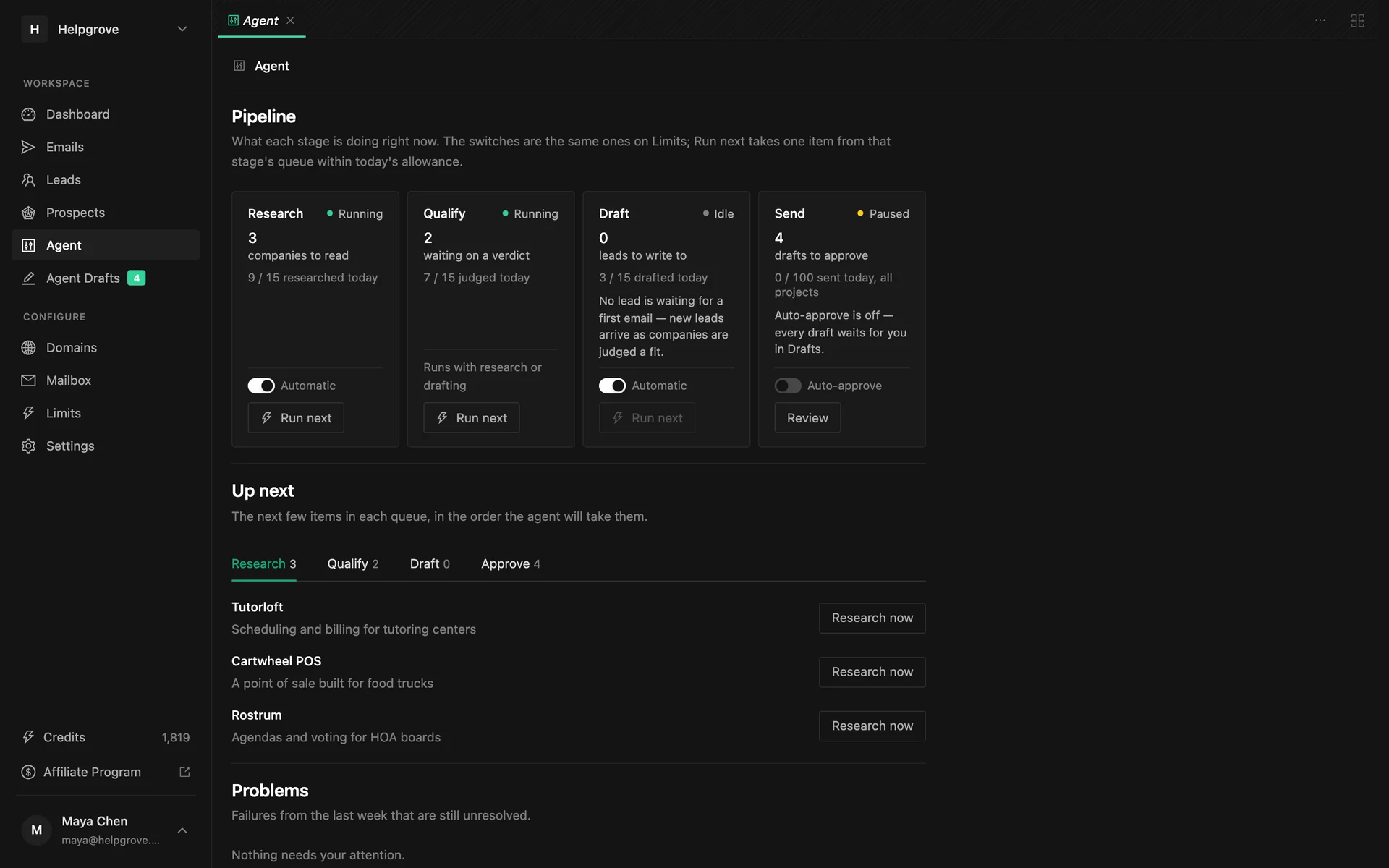
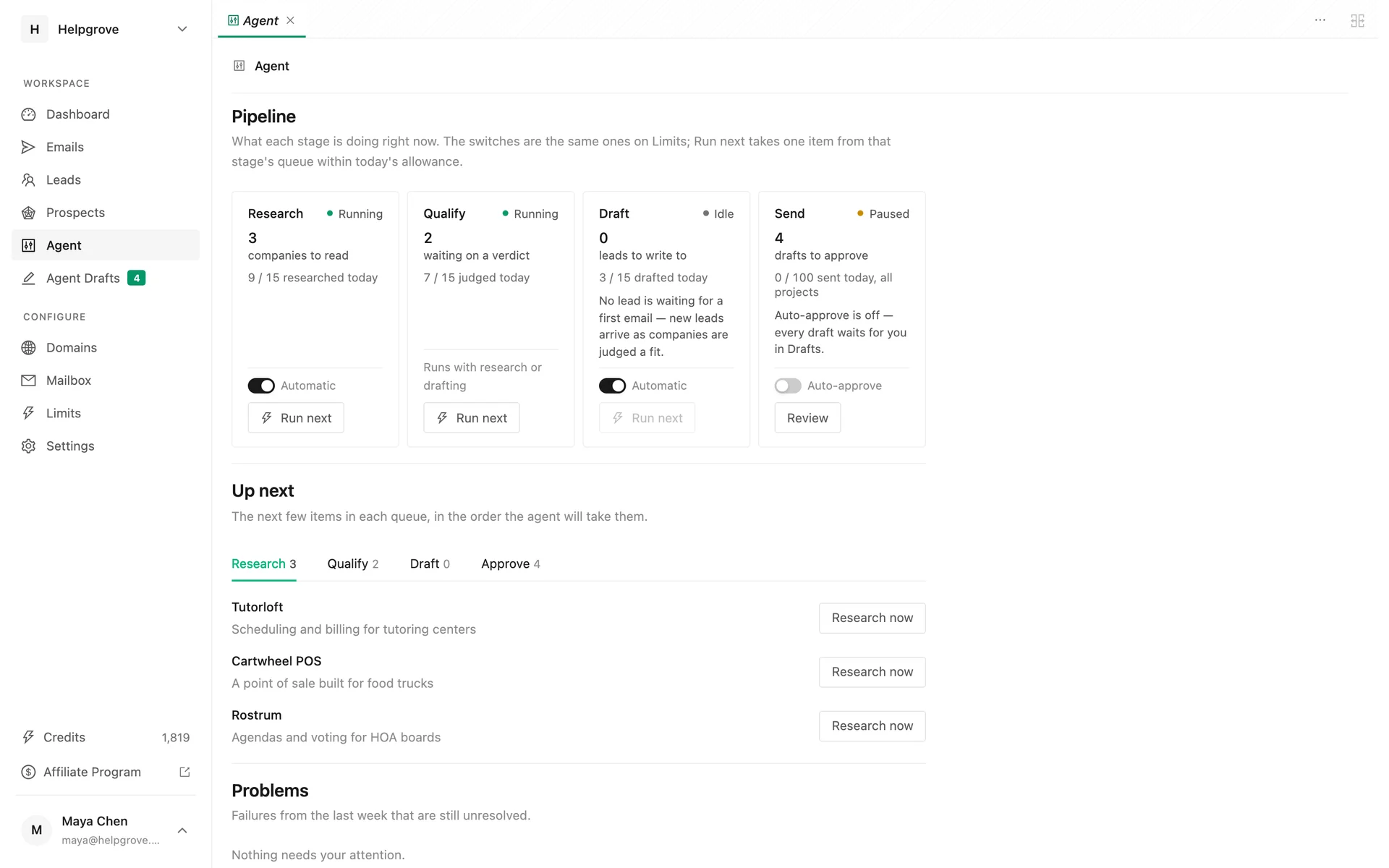
Auto-approve, off by default- Run in approval mode first. Review drafts under Agent Drafts for the first few weeks. Edit what’s wrong and note why.
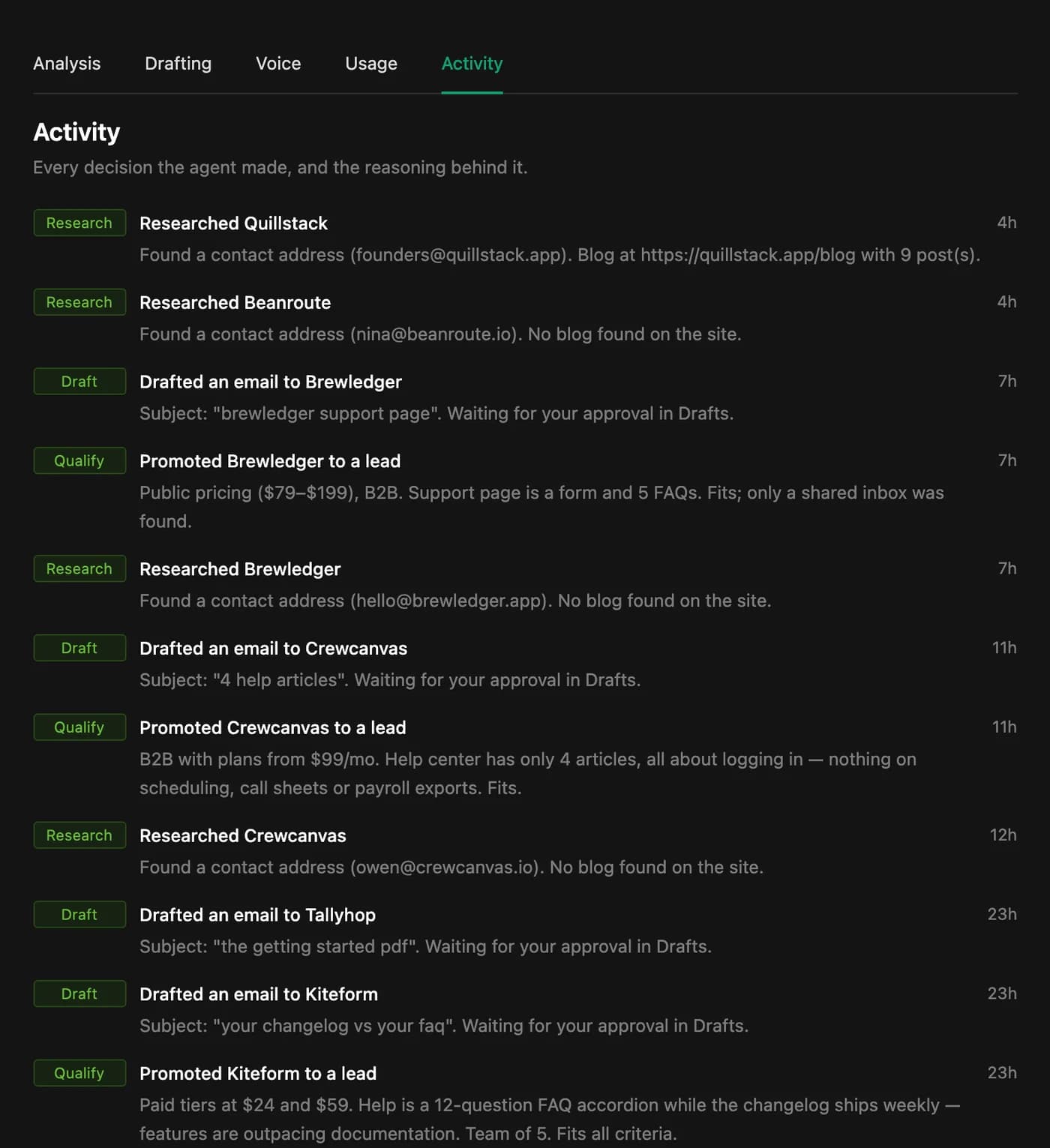
- Read the reasoning. Limits → Activity lists every decision the agent made and why, kept for 90 days. If a verdict surprises you, fix the criteria, not the email.
- Switch on auto-approve when the drafts stop needing you. Even then, it only sends to verified addresses, within your daily limits and the mailbox’s pace. A run of bounces pauses it.
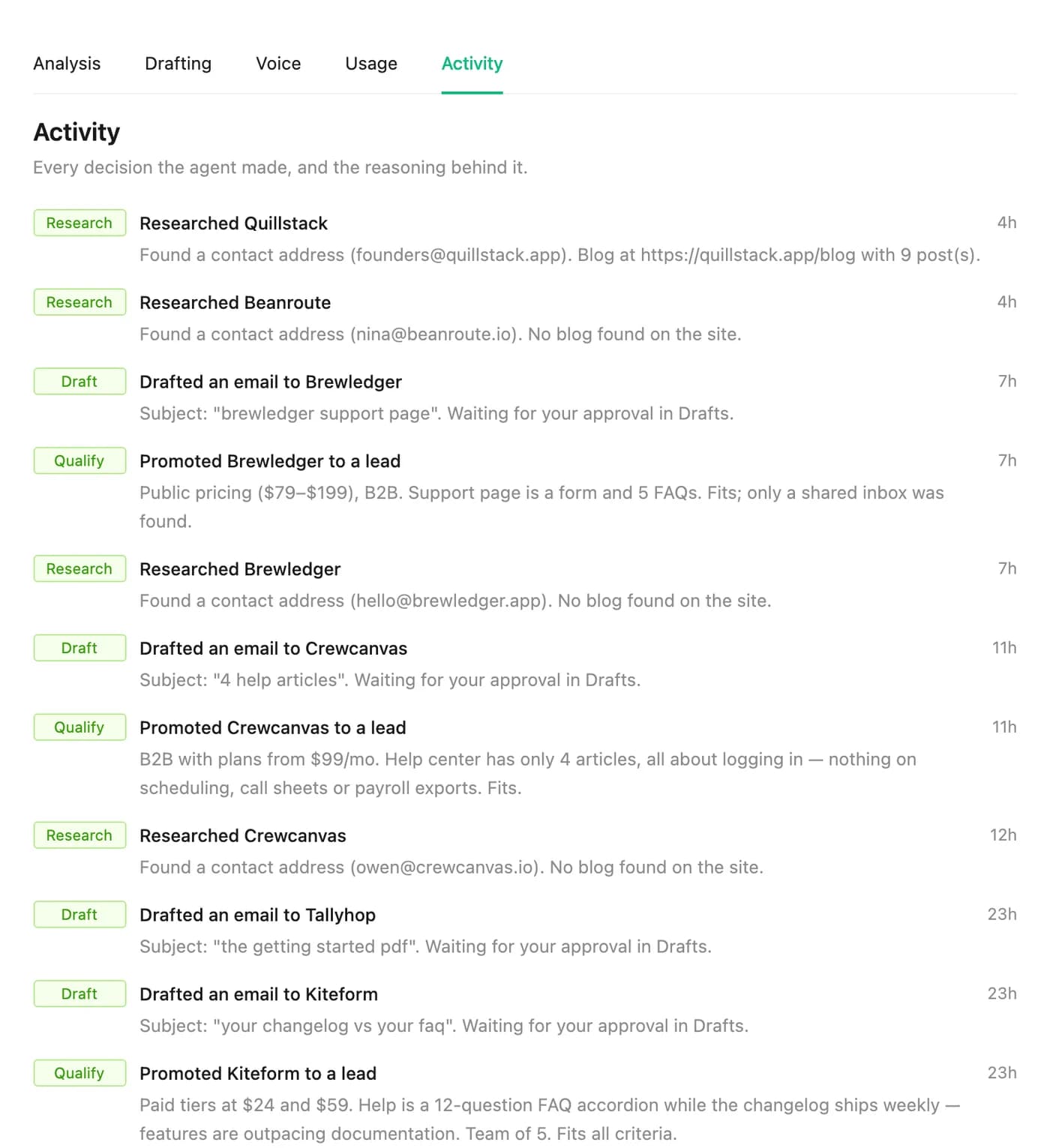
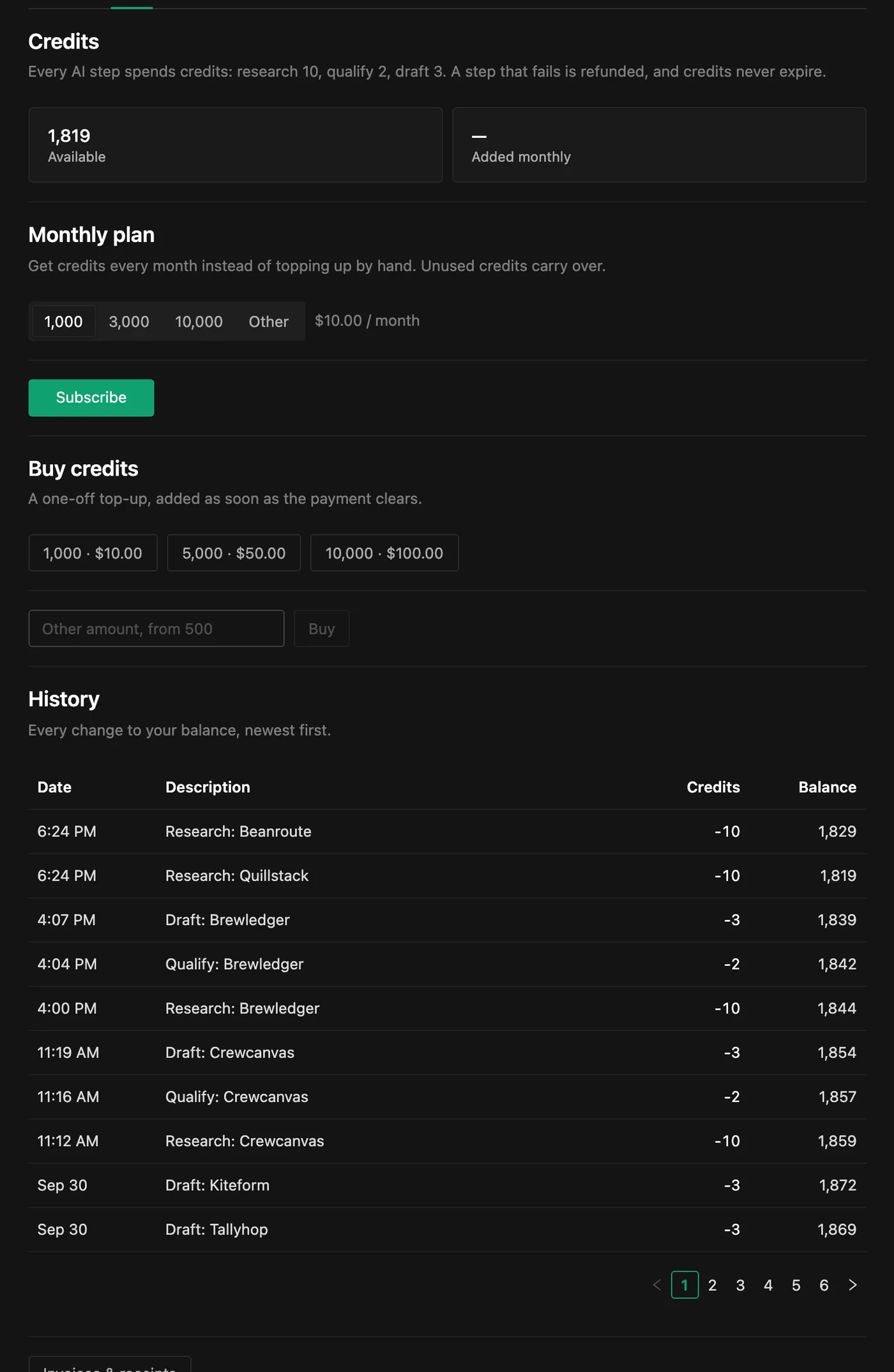
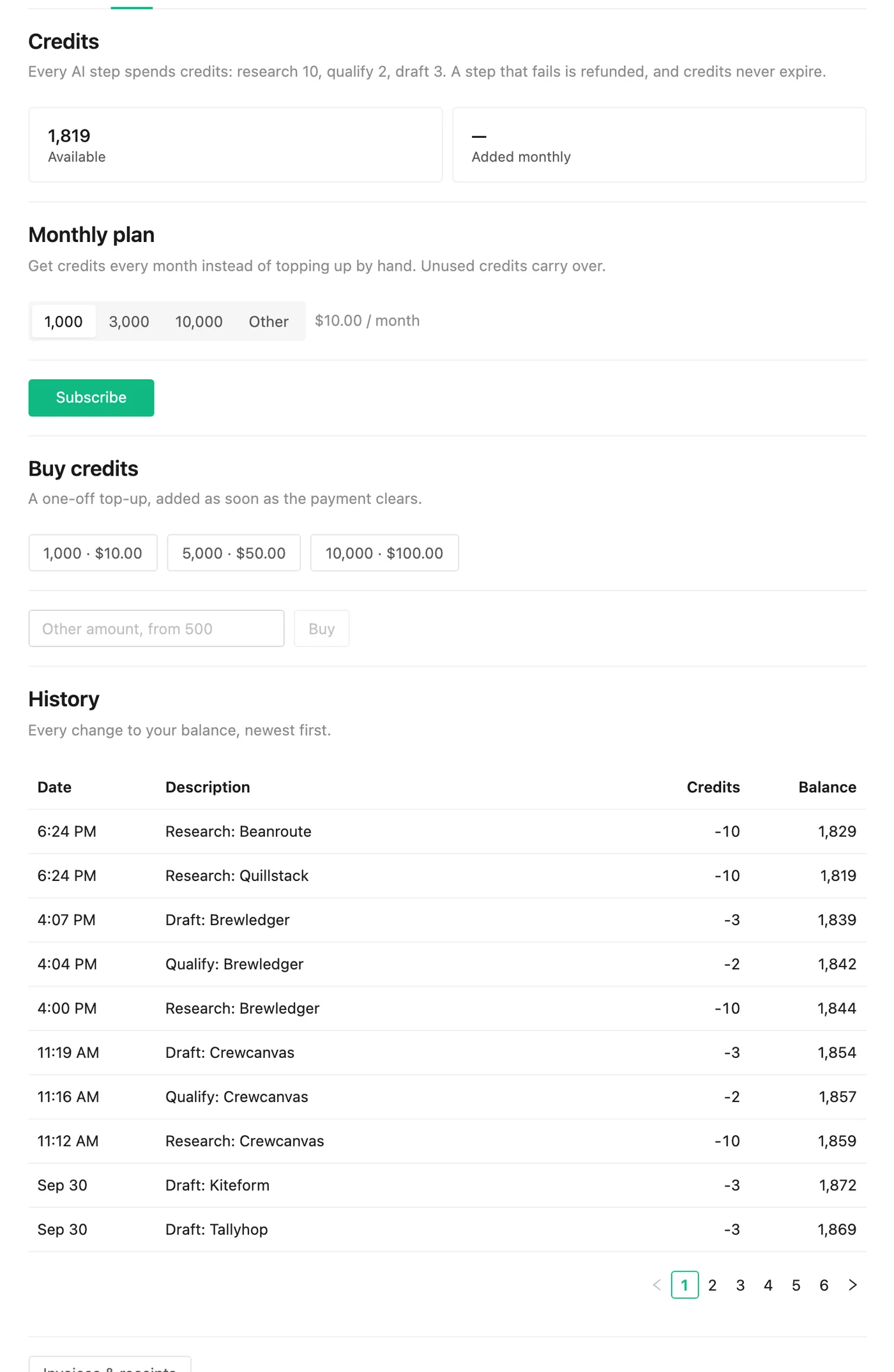
Replies are yours. They sync into each lead’s thread, and you answer them yourself. PineLead doesn’t run sequences, LinkedIn, calls or booking, so if you want the whole funnel automated, one of the platforms above is a better fit. Pricing is per step: research 10 credits, a verdict 2, a draft 3, at $0.01 a credit. Failed steps are refunded and credits never expire.
Frequently asked questions
- What is an AI SDR?
- Software that does some or all of a sales development rep’s job: finding prospects, researching them, qualifying them, writing and sending outreach, and handling replies. Products differ mainly in how much of that they do without asking a person.
- How much does an AI SDR cost?
- Listed prices on October 1, 2026 ranged from $250 a month (AiSDR Solo, 200 contacts) to $3,750 a month billed annually (11x Growth). Artisan doesn’t publish prices. Per prospect, autonomous platforms work out to roughly $1–2. Draft-and-approve tools like PineLead cost about $0.15 per company drafted, plus your review time.
- Should an AI SDR send emails without approval?
- Not at first. Start with drafts you approve, and turn on automatic sending only once you have approved a few dozen drafts in a row without meaningful edits. Even then, send only to verified addresses and within slow daily limits. Keep replies human.
- Do AI-written cold emails need an AI disclosure in the EU?
- Under Article 50 of the EU AI Act, applying from August 2, 2026, autonomous agents that write to people should disclose that they are AI and whom they act for. The Commission’s guidelines exclude AI assistance tools whose output a person reviews and sends. This is not legal advice.
- Can an AI SDR replace a human SDR?
- Not fully, on today’s evidence. Gartner expects sellers to stay differentiated on empathy, judgment and context, and SaaStr reported its AI SDRs needed 15–20 hours of human oversight a week. The realistic gain is taking research and drafting off a person’s plate.
Try it on your own market
PineLead finds new B2B prospects every day, researches and qualifies each one against your criteria, and drafts a first email you approve. Start with 100 free credits.
Keep reading
Sources
- Gartner — AI-enabled next best actions (May 2026)
- Salesforce — State of Sales 2026
- SaaStr — 6 months of AI SDRs
- Gartner — AI agents will outnumber sellers (Nov 2025)
- TechCrunch — 11x has been claiming customers it doesn’t have
- TechCrunch — AI SDR startups are booming, so why are VCs wary?
- TechCrunch — Artisan raises $25M
- Hunter — State of Email Outreach 2026
- McCarthy Tétrault — Moffatt v. Air Canada
- Artisan — Stop hiring humans
- 11x — Alice pricing
- Artisan — Pricing
- AiSDR — Pricing
- Amplemarket — Pricing
- Apollo — Pricing
- Apollo — Use agents to improve outbound work
- Instantly — Pricing
- Instantly — AI Reply Agent
- Clay — Pricing
- lemlist — lemAgent
- Gartner — Buyers validate AI insights with reps (May 2026)
- Gong — Does cold email still work?
- Goodwin — EU AI Act transparency obligations now in force
- European Commission — Guidelines on transparency obligations (Art. 50)
PineLead
Notes on finding fresh prospects and writing first emails that get a reply.