 Sev Leo, Founder of PineLead
Most ideal customer profiles are written for a pitch deck: “B2B SaaS, 10–200 employees, growth-minded teams”. A person can work with that because they fill the gaps from experience. An AI agent can’t. It has a company’s website and your words, nothing else. If your words describe things the website doesn’t show, the agent guesses, and every guess becomes an email to someone who was never going to buy.
This guide rewrites an ICP into criteria a model can check, puts the disqualifiers first, and shows how to test the result on 20 companies before it spends your budget.
Why the ICP decides your reply rate
Relevance is the main reason people ignore cold email. In Gong’s research, 87% of buyers say the sales emails they get don’t address a relevant challenge (Gong). In Hunter’s 2026 survey of decision-makers, 61% named lack of relevance as the reason they don’t reply (Hunter). Better copy can’t fix that. Better targeting can.
The effect also shows up later in the funnel. In a 2019 TOPO survey of more than 150 account-based practitioners, organizations with a strong ICP reported 68% higher account win rates (TOPO, via SalesTechStar). It’s a self-reported survey, but the direction matches what most founders learn the hard way. Lenny Rachitsky’s interviews with early-stage founders found that most got their first ICP wrong (Lenny’s Newsletter).
ICP, persona and qualification are three different jobs
- The ICP describes the company. HubSpot defines it as the “perfect company for your product or service” (HubSpot).
- The buyer persona describes the person inside that company you write to, and how to talk to them.
- Qualification decides whether one specific company meets the ICP. It’s the step an agent can do for you.
Sales frameworks like BANT, MEDDIC (created at PTC in 1996, per MEDDICC) and CHAMP are built for deal stages and need a conversation. Nobody publishes their budget or decision process on their website. Before the first email, you can observe need and, roughly, size. Everything else waits for a reply.
Write criteria the agent can observe
Clay defines a buying signal as “an observable business event that changes a company’s odds of buying”, with a source you can point to (Clay). Use the same test for every line of your ICP: could someone point to a page that proves it? If not, rewrite it or drop it.
| Pitch-deck version | Observable version | Where it shows |
|---|---|---|
| Growing B2B SaaS | Sells software to businesses, with paid plans listed | Homepage, /pricing |
| Has budget | Cheapest paid plan is $50/month or more | /pricing |
| 10–200 employees | Team page or LinkedIn link shows fewer than ~50 people | /about, /team, /careers |
| Struggles with support | Help content is a single FAQ page, or none | /help, /faq, footer links |
| Investing in growth | Hiring for sales, marketing or support | /careers |
| Modern stack | Lists a Shopify or HubSpot integration | /integrations, docs |
| Innovative, ambitious | Not checkable. Drop it. | — |
Use more than one signal. Common Room’s advice is that the strongest insights come from stacking signals (Common Room). Every founder in Lenny’s interviews ended up with at least three attributes. Three to five observable criteria is usually enough. Write the problem signal as a gap you can see: “help content is a single FAQ page”, not “needs a help center”. That gap is also what your first email will open on.
Write the disqualifiers first
Fit criteria tell the agent what to look for. Disqualifiers stop it from talking itself into a yes. “ICP fit… eliminates accounts that can never convert,” as Common Room puts it (Common Room). The two errors don’t cost the same. A company wrongly rejected is one row you never see. A company wrongly qualified is a real email to a real person, a likely ignore and maybe a spam report, which hurts your deliverability.
Two kinds of mistake, two very different costs
What happens after the agent’s verdict, depending on whether the company could really buy.
Good disqualifiers are just as concrete as the fit criteria:
- Business types that never buy: agencies, consumer apps, marketplaces, competitors.
- Already solved: “runs a full help center with dozens of articles”. Say what “solved” looks like on their site.
- Out of range: a team page with hundreds of people, or no paid plan at all.
- Dead or not real: no updates in a year, a personal side project, a parked domain.
End with a rule for missing evidence: if the site doesn’t show enough to decide, don’t qualify. Without it, a model fills gaps with plausible guesses, and hallucination in a qualification step is an email to the wrong company.
A template you can copy
A good prospect for [product]:
- [What they sell and to whom — checkable on their homepage]
- [The sign they have the problem — a page, a gap, a tool you can see]
- [The sign they can pay — public paid plans, a price floor]
- [Size or stage — from the team page, careers page or pricing tiers]

Not a fit:
- [Business types that never buy: agencies, consumer apps, competitors…]
- [Companies that already solved it — and what that looks like on their site]
- [Anything too big, too small or out of region]

If the site doesn't show enough to decide, say so and don't qualify.
Here is the same template filled in for Helpgrove, a fictional help-center tool for small SaaS teams. Every line points at something on a prospect’s own website.
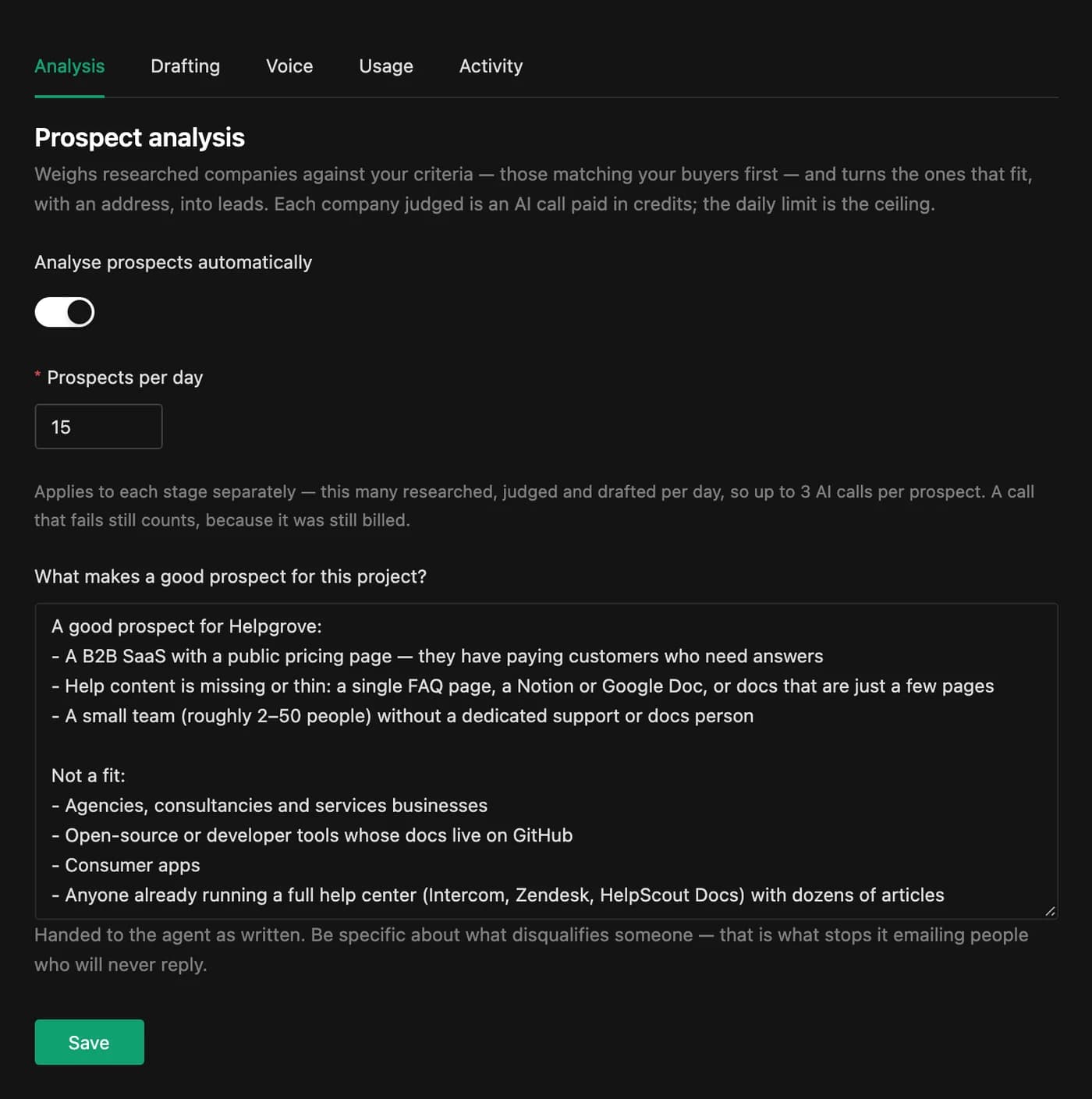
A good prospect for Helpgrove:
- A B2B SaaS with a public pricing page — they have paying customers who need answers
- Help content is missing or thin: a single FAQ page, a Notion or Google Doc, or docs that are just a few pages
- A small team (roughly 2–50 people) without a dedicated support or docs person

Not a fit:
- Agencies, consultancies and services businesses
- Open-source or developer tools whose docs live on GitHub
- Consumer apps
- Anyone already running a full help center (Intercom, Zendesk, HelpScout Docs) with dozens of articles
Test it on 20 companies before you scale
Clay’s advice for research agents holds here too: limit each agent to one task, “name the pages it should check”, and test on a handful of rows before you run at scale (Clay). For qualification, the loop looks like this:
The test loop
- Step 1WriteThree to five checkable criteria, disqualifiers first.
- Step 2Run 20A small batch, with fits and misses.
- Step 3ReadEvery verdict’s reasoning, not just the score.
- Step 4LabelEach mistake: false positive or false negative.
- Step 5Change one lineThe disqualifier or criterion behind it.
↺ Repeat until you would have sent every qualified email yourself.
Use 15 to 25 companies per batch, enough to see both fits and misses. Good reasoning names its evidence (“help is one /faq page with 9 questions”); vague reasoning means the agent couldn’t find what you asked for. A false positive usually points to a missing disqualifier. A false negative usually means a criterion is too literal, or asks for something the site can’t show.
Expect to keep refining. PostHog’s rule of thumb is that five paying customers who look the same is a good sign and ten is very strong, and that getting the ICP right takes three months to a year (PostHog). The criteria you write in week one are a starting hypothesis.
Five ways criteria go wrong
- Adjectives instead of evidence. “Fast-growing” and “sophisticated” mean nothing to a model reading a homepage.
- Data the site doesn’t have. Revenue, funding stage and churn are rarely on a company’s own website. Leave them out unless you also supply the data.
- Too many ANDs. Seven required criteria means almost nothing qualifies, and what does is often a misread.
- Unstated assumptions. If you only sell in the US or only in English, say so.
- Describing your product instead of their situation. “Would benefit from AI-powered help docs” is your pitch. “Has no searchable help content” is their situation.
Doing this in PineLead
In PineLead
Criteria in plain English, verdicts you can read
PineLead finds new companies every day and researches each one’s public website: what it sells, its pricing, its help and blog pages, and any published contact address. Your criteria are then handed to the qualifier as written. It judges only on that research. When the research is missing something a criterion depends on, it says so and leans towards not qualified.
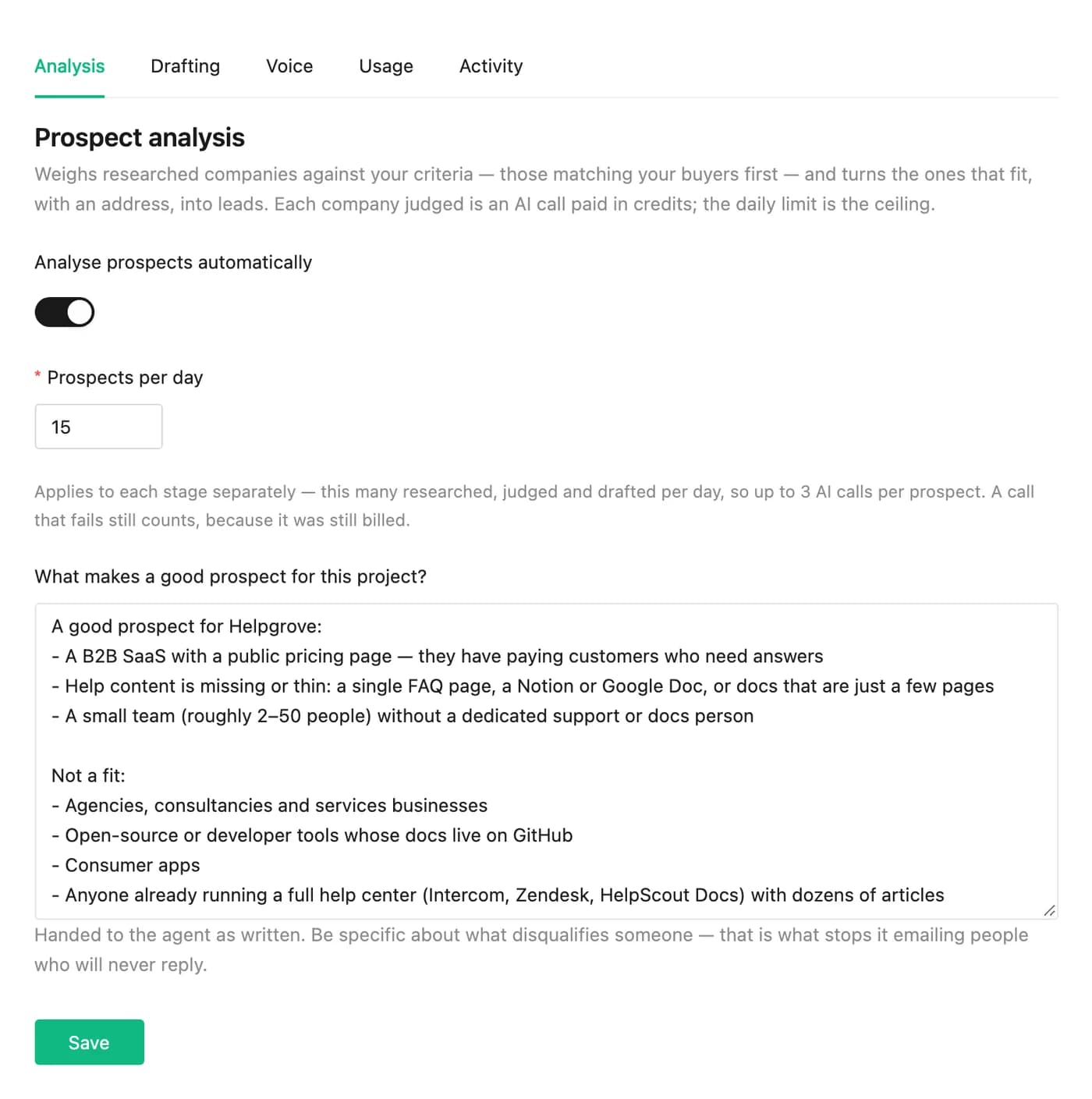
- Open Configure → Limits → Analysis and paste your criteria into What makes a good prospect for this project?
- Set Prospects per day low for the first run (10 to 15), and turn on Analyse prospects automatically.
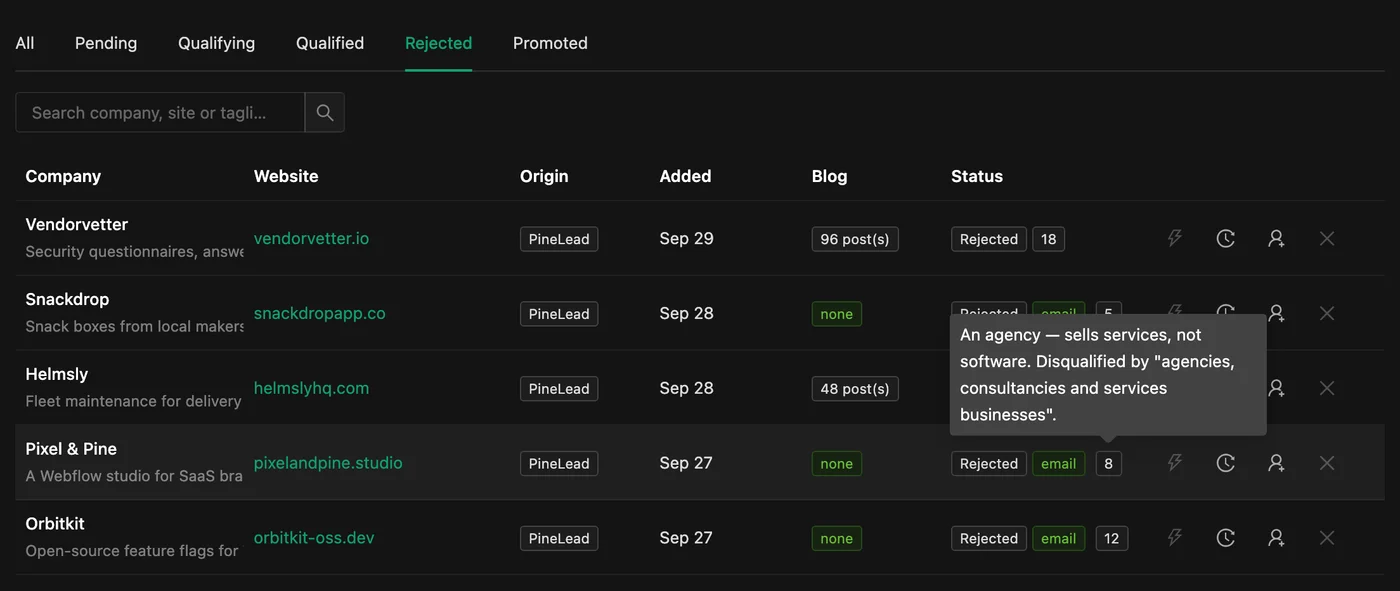
- Open Prospects. Every company has a status and a score from 0 to 100. Hover the score to read the reasoning, or filter to Rejected to check the disqualifiers.
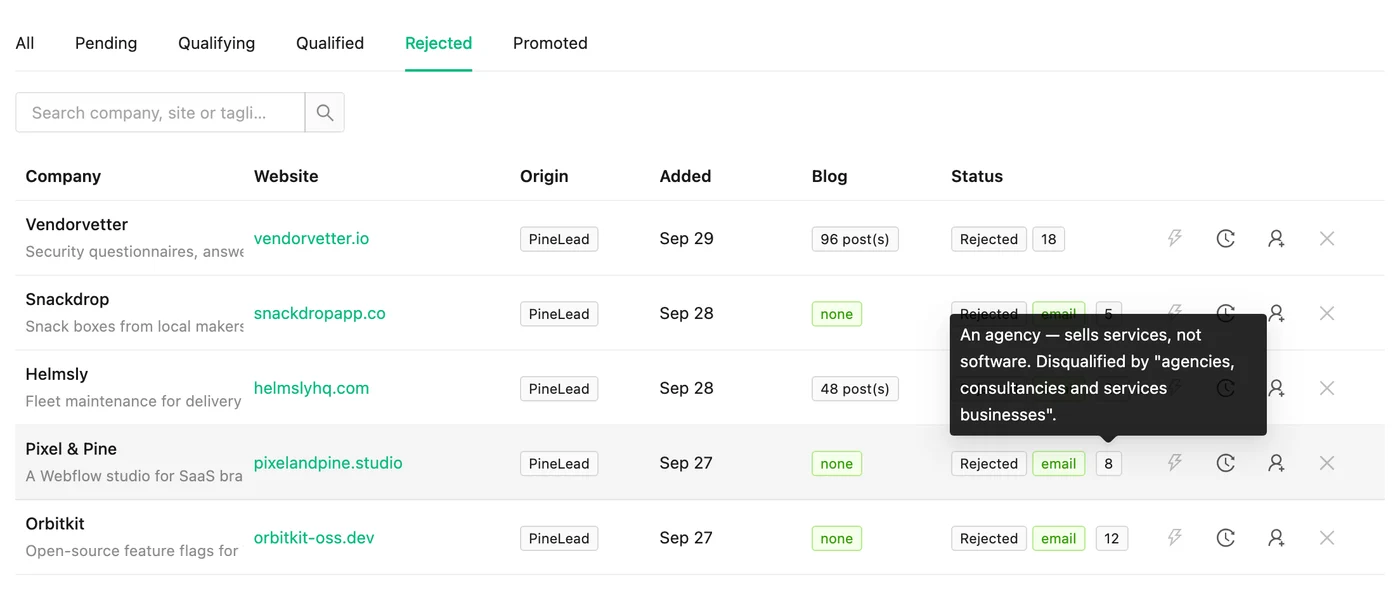
- For the full trail on one company, press the history icon on its row. You’ll see what research found, the verdict, and the draft it led to.
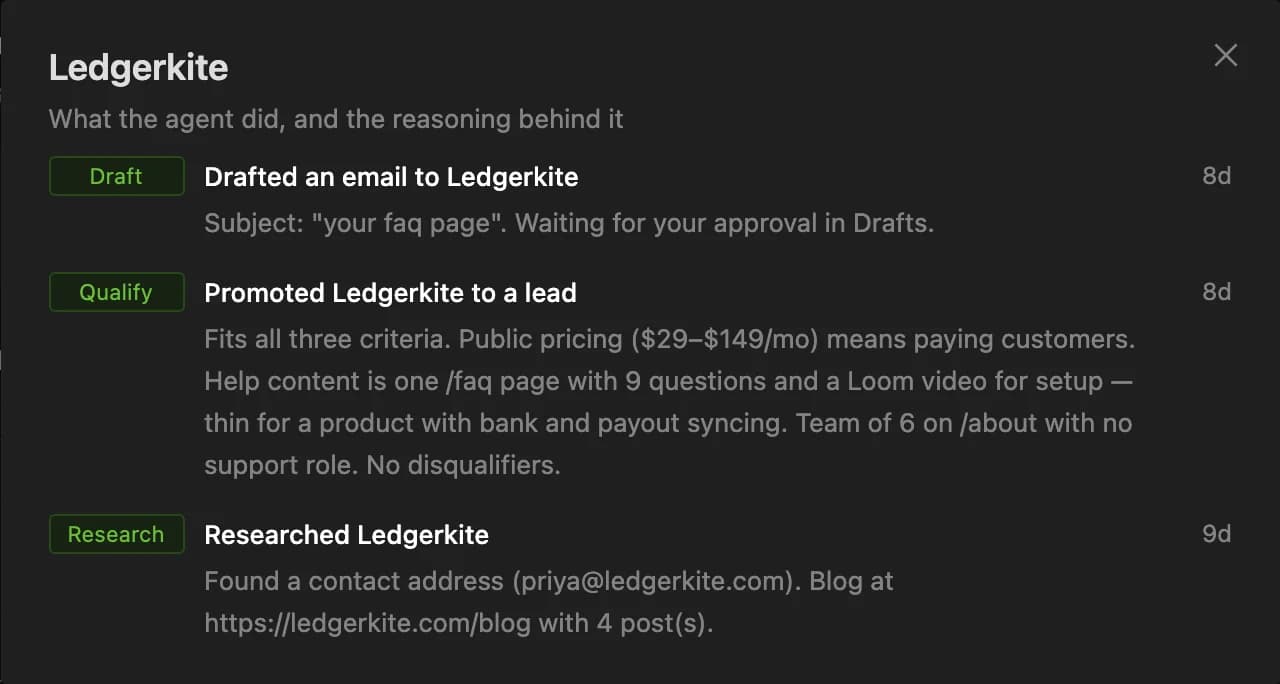
A qualified company with a deliverable address becomes a lead and gets a draft. A qualified company with no address stays under Qualified for you to pick up by hand. To push one company through right away, use ⚡ on its row. For a quick test batch, use Limits → Usage → Run now. Research costs 10 credits and a verdict 2 (pricing), so a 20-company test costs about $2.40. The scoring scale is calibrated: 85 and above only when every criterion has evidence, below 40 for a clear miss.
Frequently asked questions
- What is the difference between an ICP and a buyer persona?
- An ideal customer profile describes the company you want to sell to: what it does, its size, its situation. A buyer persona describes the person inside that company you write to. You qualify companies against the ICP, and you write the email for the persona.
- How many criteria should an ICP have?
- Three to five observable fit criteria plus a short list of disqualifiers is usually enough. Fewer and the agent qualifies too much. More, especially if all of them are required, and almost nothing qualifies.
- Can an AI agent use BANT or MEDDIC to qualify leads?
- Not before the first email. BANT and MEDDIC ask about budget, authority, decision process and timing, which companies don’t publish on their websites. Before you make contact, an agent can judge need and rough size from public pages. The deal-stage frameworks come in once someone replies.
- What should an agent do when the website doesn’t show enough?
- Not qualify. Say so explicitly in your criteria. A wrongly qualified company costs a real email and some reputation, while a wrongly rejected one costs a single row you never see.
- How do I test new qualification criteria?
- Run them on 15 to 25 companies, read every verdict’s reasoning, label the false positives and false negatives, change one line, and run again. Scale up once you would have sent every qualified email yourself.
Try it on your own market
PineLead finds new B2B prospects every day, researches and qualifies each one against your criteria, and drafts a first email you approve. Start with 100 free credits.
Keep reading
Sources
- Gong — 4 data-backed ways to increase your reply rate
- Hunter — State of Email Outreach 2026
- TOPO Account Based Benchmark Report (2019), via SalesTechStar
- Lenny’s Newsletter — How to identify your ideal customer
- HubSpot — ICPs and buyer personas
- MEDDICC — Who created MEDDIC
- Clay — How to identify buying signals
- Common Room — 30 examples of buying signals
- HowToWeb — 5 questions with April Dunford
- a16z — A framework for defining and refining your ICP
- Common Room — Account prioritization
- Clay — Agent use cases for GTM
- PostHog — The ideal customer profile framework
PineLead
Notes on finding fresh prospects and writing first emails that get a reply.